


For years, Building Information Management (BIM) has been regarded as a powerful tool for architects and designers. In the early days, it was primarily used to improve design accuracy, clash detection, and visualization during preconstruction. But as the industry has evolved, one truth has become clear: BIM achieves its full value only when it extends beyond the office and into the field.
Owners, architects, and contractors all stand to gain when field teams have access to the same real-time information as the design office. The job site is where ideas meet reality, and when BIM lives there too, projects become more coordinated, efficient, and predictable.
Breaking Down the Silos & Closing the Gap Between Design and Construction
Traditionally, construction relied on static 2D drawings and paper sets delivered to the field. Updates and revisions were communicated through phone calls, emails, or RFIs—an inherently slow process that often resulted in outdated information being used to guide critical decisions.
.png?width=966&height=357&name=image%20(14).png)
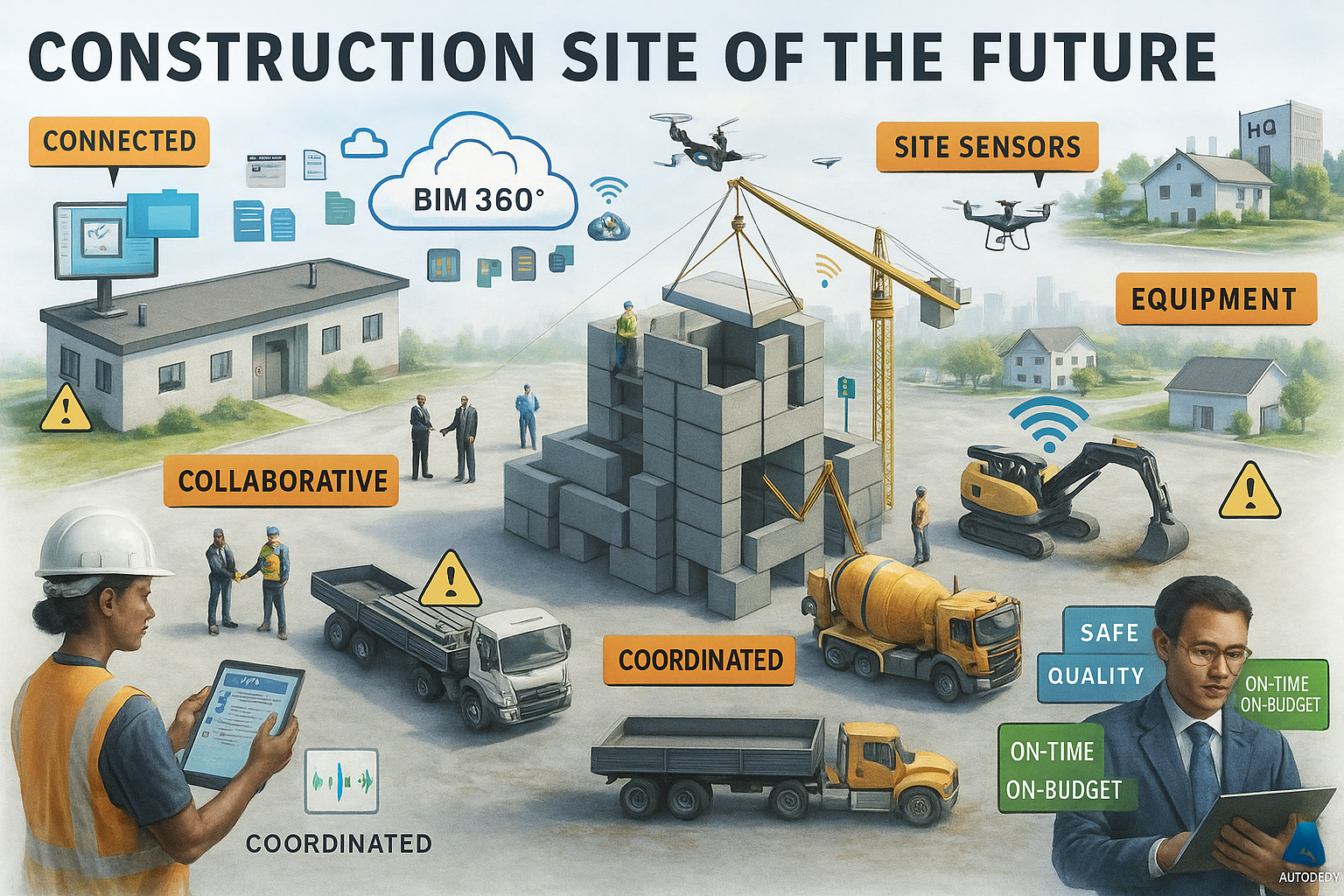
By bringing BIM to the job site, teams break free from this outdated cycle. Field personnel can access the live model on tablets or mobile devices, ensuring they’re working with the most current design intent. Instead of waiting for clarifications or revised sheets, they can visualize exact system layouts, detect conflicts before they become costly issues, and coordinate more effectively with other trades.
This “single source of truth” fundamentally changes the pace and quality of collaboration.
Smarter, Faster Decision-Making
The construction site is an environment of constant decision-making. Where should the next run of ductwork or plumbing lines go? Can a drain be shifted to avoid a structural beam? How should an unforeseen condition in the field be resolved without delaying the schedule?
.png?width=1960&height=819&name=image%20(15).png)
With BIM in the field:
- Owners see the reassurance that what’s being built is consistent with the design and their investment goals.
- Architects can validate intent more easily, reducing rework and design changes.
- Contractors and trade partners can coordinate live in the field, minimizing conflicts and accelerating schedules, allowing for faster turnaround.
- Instead of relying on layers of back-and-forth communication, questions can be answered in real time—often by walking the model in the field.
Tangible Benefits for All Stakeholders
The impact of on-site BIM use can be measured in several ways:
- Reduced errors and rework – Clash detection doesn’t end at preconstruction. Field-accessible models allow teams to catch conflicts during installation and find resolution, saving both time and money.
- Improved coordination – Trades can visualize where their work fits into the larger system, reducing overlap and creating smoother workflows, and most times tighter schedules.
%20(14).png?width=2524&height=1262&name=Untitled%20(2524%20x%201228%20px)%20(14).png)
- Enhanced productivity – Immediate access to the latest model data eliminates wasted time hunting for updates or waiting for answers.
- Stronger safety outcomes – With better visualization of spatial constraints and sequencing, crews can anticipate hazards before they arise.
- Greater owner confidence – Real-time alignment between design and construction provides transparency and reinforces trust.
The Future of BIM is in the Field
-
For owners and architects, BIM on the job site isn’t just a “nice to have” its becoming an industry expectation. As projects grow in complexity and delivery models shift towards collaboration, the ability to provide the field with real-time access to accurate information is no longer optional.
-
The teams that embrace this approach are not just building projects, they are building smarter, more connected processes. They are positioning themselves as partners who value clarity, efficiency, and long term client satisfaction.
Conclusion
BIM is more than a design tool; it’s a construction enabler. Bringing it to the field bridges the critical gap between vision and execution. Owners gain better alignment with their investment. Architects see their designs realized with fewer compromises. Contractors work more efficiently, with fewer surprises.
Ultimately, projects that leverage BIM in the field deliver outcomes that are smarter, faster, safer, and more predictable. And that’s why it matters.
.png?width=1350&height=900&name=image%20(16).png)